


San Miguel de Allende
Water in San Miguel de Allende:
Your Questions, Answered
Straightforward information about water quality, safe drinking water options, and the regional water crisis, from the team that has been working on this for over 15 years.
Your Water & Your Home
Practical information for residents, newcomers, and visitors in San Miguel de Allende: what is safe to drink, which filters work, and what to do.
No. Tap water in San Miguel de Allende and the surrounding region should not be consumed without treatment. While the municipal system chlorinates water to address biological contamination, much of the regional groundwater contains arsenic and fluoride at levels above health guidelines.[1] These contaminants are invisible — they have no color, taste, or smell. Chlorine, boiling, and most standard water filters do not remove them.
San Miguel's urban water supply is drawn from a number of different wells with varying water quality. These sources are blended together before reaching your tap, and which wells are active can change over time. A test result from your tap today does not guarantee the same result next month.[2]
Using tap water for bathing, washing dishes, laundry, or cleaning is not associated with health risks from these contaminants.
Arsenic is classified as a Group 1 human carcinogen by the International Agency for Research on Cancer. Long-term exposure through drinking water is associated with cancers of the skin, bladder, and lung, as well as skin lesions (keratosis), cardiovascular disease, diabetes, and adverse developmental effects in children.[3] There is also growing evidence linking arsenic exposure to chronic kidney disease; studies suggest a 30% increase in kidney disease risk at concentrations above 50 µg/L.[4] These effects accumulate slowly over years of regular consumption; people feel fine while exposure builds.
Fluoride at elevated concentrations causes dental fluorosis: permanent brown or white staining and structural weakening of tooth enamel that cannot be reversed.[5] At sustained higher exposure, it causes skeletal fluorosis, a painful and progressive hardening of bones. Chronic fluoride exposure is also linked to kidney damage over time. There is additionally a growing body of scientific evidence linking higher fluoride exposure during pregnancy and early childhood to effects on cognitive development, including lower IQ scores in children.[6]
Children and pregnant women are most vulnerable. Children absorb fluoride at significantly higher rates than adults: up to 80% of ingested fluoride may be retained in developing bones and teeth, compared to roughly 50% in adults. This is why protecting children's drinking and cooking water is especially urgent.[5]
The relevant health effects are associated with long-term oral consumption, not with occasional use or skin contact. The priority is your daily drinking and cooking water.
You have three main options, each with real trade-offs:
- Reverse Osmosis (RO): best long-term household solution. A properly installed and maintained under-sink RO system reliably removes arsenic and fluoride. It is the most cost-effective solution over time for households that plan to stay in SMA. See Q5 for details on choosing and buying a system.
- Rainwater Harvesting: excellent where feasible. Rainwater is naturally free of arsenic and fluoride. If properly collected, stored, and treated to remove bacteria, it is one of the cleanest water sources available in this region. Best for homes with adequate roof surface and storage capacity. It requires a biological treatment step. See Q6.
- Commercial bottled water (garrafones): convenient but costly. Large 10- or 20-liter refillable jugs from reputable suppliers are a reliable fallback. Look for suppliers using documented RO treatment. One brand many in SMA trust is Marnier, whose plant uses high-quality RO, but always ask about treatment methods. Be cautious with neighborhood refill stations, which may not use RO and therefore may not remove arsenic and fluoride.
No, not for arsenic and fluoride. Caminos de Agua has tested Berkey filters extensively in this region, including their add-on fluoride cartridges, and they do not provide meaningful protection against the contaminants found in local groundwater. The same is true of other countertop gravity filters, including Nikken and EcoFiltro.
These filters are generally designed for markets where tap water already meets basic safety standards. They do a reasonable job with taste, odor, chlorine, and some bacteria, but arsenic and fluoride are dissolved elements that require either reverse osmosis or specialized filtration media (such as bone char or iron-oxide media) to remove effectively. Activated carbon can remove some arsenic and fluoride initially, but its capacity is quickly exhausted and it stops providing meaningful protection well before most users would think to replace it. Ceramics (the other common media in gravity filters) do not remove them at all.
An additional concern: most gravity filters give no clear signal when they are no longer working. A filter that has exceeded its capacity can provide a false sense of security while offering no actual protection.
Reverse osmosis works by forcing water under pressure through a very fine semi-permeable membrane that blocks dissolved contaminants, including arsenic, fluoride, salts, and most other minerals, while allowing water molecules through. A small amount of water is discharged as waste in the process.
What to look for:
- NSF/ANSI 58 certification: this is the standard that confirms arsenic and other dissolved-mineral removal;[7]
- A documented maintenance schedule: filters and membranes need regular replacement to stay effective;
- A reasonable water efficiency ratio: older systems can waste 4–8 liters for every clean liter produced; newer tankless models typically achieve 2:1 or better;
- Local availability of replacement cartridges: some premium imported brands are excellent but difficult to service in Mexico.
Types available: Under-sink systems (with or without a storage tank) are the most common for households. Newer countertop RO units offer portability, which is useful for renters. Whole-house systems are an option but add significant cost and complexity.
Where to buy in San Miguel:
- Local hardware stores: Don Pedro on the Salida a Celaya carries RO systems and replacement cartridges, and staff can often advise on installation;
- Online: Mercado Libre Mexico and Amazon Mexico both carry a wide range of under-sink and countertop RO systems, often at better prices than retail, with delivery to SMA.
Installation and maintenance: Most under-sink systems can be installed by any plumber familiar with standard kitchen plumbing. Maintenance involves replacing pre-filters every 6–12 months and the membrane every 2–3 years, depending on usage and water quality. If you need a recommendation for a reliable installer or technician in SMA, use our Contact Form; we keep an updated list.
We've put together a short guide on how to use a TDS meter: TDS Guide (English) | Guía TDS (Español)
Yes, when designed and maintained correctly. Rainwater is naturally free of arsenic and fluoride, which makes it one of the cleanest source water options available in this region. It does, however, need biological treatment before drinking, since rooftop collection can introduce bacteria. In urban environments, where roofs and cisterns are more exposed to dust, pollutants, and other contaminants, we also recommend an activated carbon filter as an added layer of protection.
Key design considerations:
- Storage volume: systems need to store enough water during the rainy season (roughly June–October) to carry a household through seven or more months of dry season;[8]
- First-flush diversion: the first rain after a dry period carries roof contaminants and should be diverted away from storage;
- Biological treatment: a ceramic or other appropriate filter, or UV treatment, is required before drinking; in urban settings, adding an activated carbon filter is also recommended;
- Roof material: some waterproofing chemicals can leach into collected water; bare concrete or terracotta are generally safe, while painted or chemically treated surfaces need evaluation.
Some households in SMA combine rainwater harvesting (for drinking and cooking) with tap water (for everything else) and keep bottled water or RO as a backup during the dry season.
Yes. Caminos de Agua offers water testing services for households and communities. We can help you understand what is in your water and what treatment options make sense for your situation. Visit our water testing page for information on submitting a sample.
A few things worth knowing about urban water testing in SMA: water quality at any given tap can vary over days or weeks, because the municipal system draws from multiple wells and the blending changes. A single test result gives you a useful snapshot but not a permanent guarantee. This is one reason Caminos recommends that all households in the region adopt a safe water solution for drinking and cooking, regardless of what their current test shows.
If you're buying or building:
- Ask where the water comes from: municipal piped system, private well, or water delivery (pipa);
- Check whether the home has an existing RO system or rainwater harvesting in place, and if so, when filters were last serviced;
- Confirm storage capacity: rooftop tinaco size and any underground cistern, relative to your household's needs;
- If buying, seriously consider whether an RO system is in place. Installing one is straightforward and will save money and hassle compared to relying on bottled water for years;
- New construction is the best opportunity to integrate rainwater harvesting at minimal extra cost. Roof connections, first-flush diverters, and cistern plumbing are far cheaper to build in than to retrofit later. See our rainwater harvesting resources for sizing and design guidance.
If you're renting:
- Talk to your landlord about installing an RO unit, as many are open to it as a permanent improvement to the property;
- Newer tankless RO models can be installed and removed relatively easily if you need to take the system with you;
- In the meantime, commercial bottled water from a verified source (see Q3) is a reliable short-term fallback.
Yes. The water crisis in SMA's urban area is real, but the communities hit hardest are in the rural parts of the watershed, where groundwater contamination is often more severe and household-level solutions like RO are less accessible or affordable.
Caminos de Agua works directly with these communities on rainwater harvesting systems, community-scale groundwater treatment (Nuestra Agua), water quality monitoring, and local leadership development through the Water School program. None of this work is possible without community buy-in, technical partnership, and sustained funding.
If you'd like to contribute, visit caminosdeagua.org/donate. You can also reach out to learn about other ways to get involved, from introducing us to potential funders to hosting a conversation with your neighbors.
The Bigger Picture
For those who want to understand the regional water crisis: where the contamination comes from, why the aquifer is declining, what agriculture has to do with it, and what is being done.
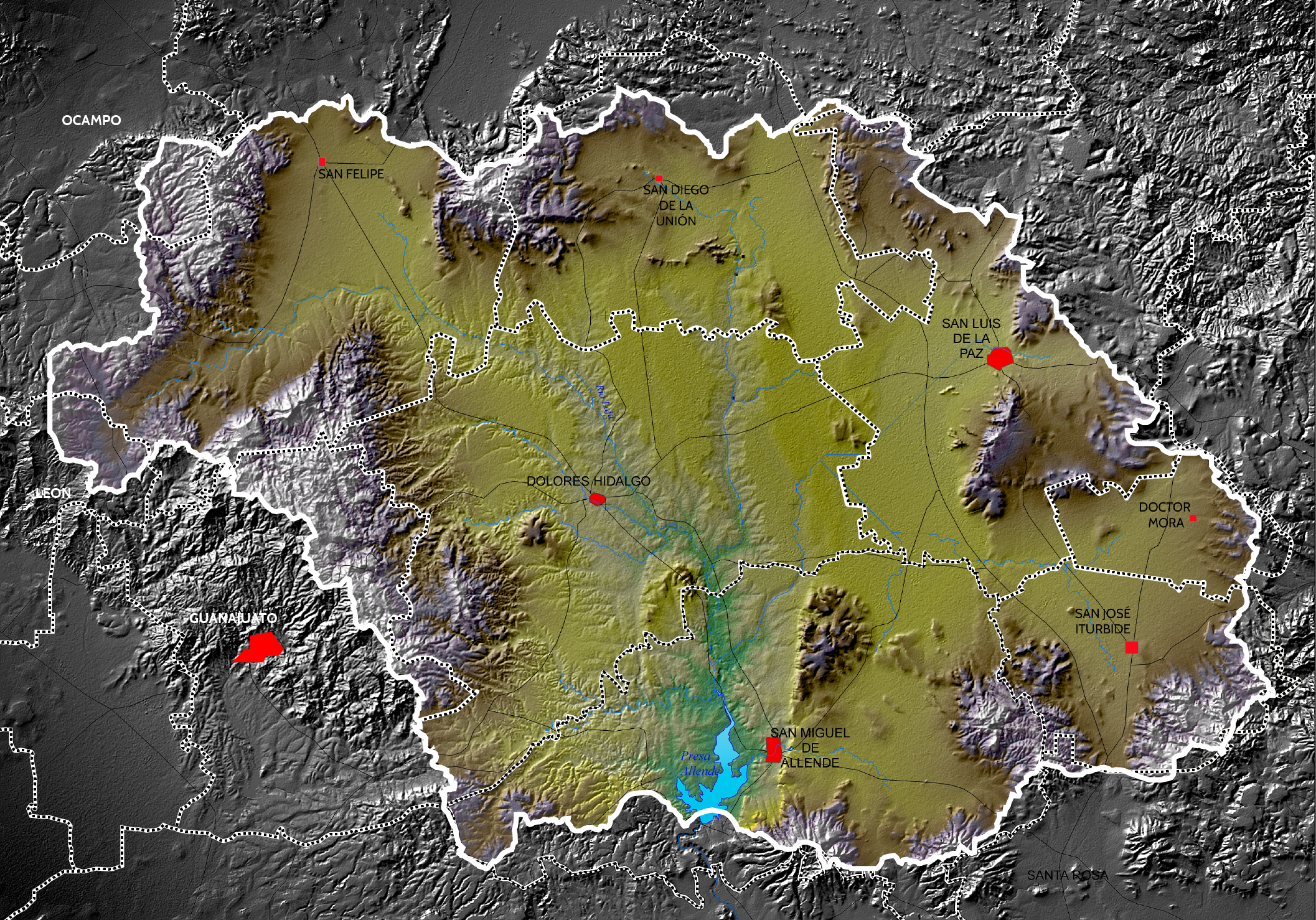
Most of the water used in the San Miguel de Allende region comes from groundwater: water extracted from underground geological formations called aquifers. The region sits within the Upper Río Laja Watershed in northern Guanajuato, also known as the Independence Watershed. This area spans seven municipalities: San Miguel de Allende, Dolores Hidalgo, San Felipe, San Diego de la Unión, San Luis de la Paz, Doctor Mora, and San José Iturbide, home to approximately 744,000 people combined.[2]
Underneath this watershed, four main aquifers provide the groundwater used for agriculture, public water supply, and industry: Cuenca Alta del Río Laja, Laguna Seca, San Miguel de Allende, and Doctor Mora–San José Iturbide.
Unlike many regions that also draw on rivers, lakes, or reservoirs, this area depends heavily on groundwater with limited surface water alternatives. That dependence makes the aquifer's health central to everything, and its current state of overextraction and contamination a genuine regional crisis.
Yes, and the evidence is clear. The aquifer is being extracted faster than it is naturally replenished, meaning water levels drop every year. Based on Caminos de Agua's analysis of piezometric monitoring data across the core watershed, the long-term decline rate in most of the region falls in the range of 0.5 to 2.0 meters (~1.5 to 6.5 feet) per year, with some wells and local areas declining faster.[9]
To put that in context: at the lower end, wells in this region may drop half a meter annually; at the upper end, they can drop two meters. Over decades, this means water that was accessible at 100 meters depth may now require drilling to 150 or 200 meters, at far greater cost and with no guarantee of finding uncontaminated water at greater depth.
All four of the main aquifers underlying the watershed are classified by Mexico's National Water Commission (CONAGUA) as overexploited or without available water, meaning they are not in a state where new extraction should be permitted, let alone increased. In Guanajuato state as a whole, 65% of aquifers are classified as overexploited, and those aquifers account for 95% of all groundwater concessions in the state.[10]
Arsenic and fluoride in our groundwater are geogenic: the contamination comes from the natural geology of the region, not from pollution or human activity. The volcanic and mineral-rich rocks that make up the aquifer contain these elements, and over time groundwater slowly dissolves them from the surrounding rock. This is a widespread phenomenon in semi-arid regions with volcanic geology, affecting communities across central Mexico, large parts of South and Southeast Asia (including Bangladesh, India, Pakistan, China, Vietnam, and Nepal), sub-Saharan and East Africa, parts of Europe, central Australia, and areas of South America including Argentina and Chile.[11]
Aquifer overextraction makes this worse in a few ways. When water is pumped out faster than it is replenished, recharge pathways change and different groundwater chemistries can mix. Zones that once had acceptable water quality can deteriorate over time. The relationship between well depth and contamination is also not straightforward: arsenic and fluoride concentrations are not simply a function of how deep a well is drilled. The geology of the specific location, including volcanic rock composition, redox conditions, and flow patterns, matters more than depth alone.
The contamination is not uniformly distributed. Caminos de Agua has tested more than 1,100 water sources across the region; of rural community wells tested, roughly 60% exceeded current Mexican regulatory limits for arsenic, fluoride, or both. The highest levels Caminos has recorded are up to 24 times the Mexican regulatory limit for arsenic and up to 18 times the limit for fluoride.[1]
Agricultural water use is the dominant driver of aquifer overextraction in this region. Based on CONAGUA concession data, agriculture accounts for roughly 80–90% of all groundwater allocated in the watershed, a figure consistent with patterns across Guanajuato state, where agriculture holds approximately 76% of total water concessions.[10]
The dominant irrigated crops in the region include alfalfa (which alone has historically represented 60–70% of irrigated agricultural production by volume in the watershed), broccoli, cauliflower, asparagus, and grain corn. A significant portion of the vegetable production in Guanajuato is destined for export to North American markets, and this is part of the pressure on the shared aquifer. At the same time, much of the alfalfa production likely supports domestic cattle ranching. The full picture of who uses how much water, for what purpose, and with what legal authorization is poorly documented — a reflection of weak water governance more than any single industry.[12]
What is clear is that current extraction far exceeds sustainable levels, and that meaningful change requires reform of the water concessions system, stronger enforcement, and governance structures that account for the rights and needs of all users, including rural communities who depend on the aquifer for drinking water.
The evidence on rainfall here is more nuanced than many people assume. Analysis of weather station data from 17 stations across the watershed (covering 1970–2019) shows that total annual rainfall in the region has actually increased modestly over the past four decades, the opposite of what is sometimes stated. The proportion of rain falling during the traditional rainy season (June–September) has also remained stable. There is no clear evidence from historical data that the rainy season is getting shorter or that precipitation is declining.[8]
That said, future projections tell a different story. IPCC climate models project a long-term decrease in total precipitation for this region over the coming decades, particularly under higher warming scenarios. And even if total rainfall holds steady, there is increasing evidence of more intense but shorter rain events, which can cause runoff and erosion rather than recharging the aquifer.[13]
The core of the current crisis is not primarily a rainfall problem. It is an extraction problem: the aquifer is being pumped out faster than rain can replenish it, regardless of how much it rains. Climate change may worsen future water availability, but addressing current aquifer overextraction is urgent now, independent of future rainfall trends.
Caminos de Agua works on the human consumption water access and public health side of this crisis through three interconnected programs:
- Rainwater Harvesting: As of early 2026, Caminos has built more than 1,800 household rainwater harvesting systems across approximately 200 rural communities, giving families access to a water source naturally free of arsenic and fluoride. Local technicians are now trained to install and maintain these systems independently;
- Nuestra Agua: a community-scale groundwater treatment system that removes arsenic using iron-oxide filtration media and fluoride using bone char produced by Caminos at its Field Center. As of early 2026, three systems are operating (serving the communities of Los Ricos, Alonso Yáñez, and San Elías), and conversations are underway about a fourth with state government support. The long-term goal is to establish a network of community-led systems across the watershed and to partner with communities and organizations across Mexico to bring this model to other regions facing the same crisis;
- Water School: a two-year apprenticeship program that trains young people from rural communities in water science, community organizing, and water system management. Thirty-nine apprentices are enrolled in the inaugural cohort.
Caminos also maintains an open-access water quality database covering more than 1,100 sites tested directly by our team, available at our water quality map. The map also incorporates thousands of additional data points from a national collaboration with CONAGUA and academic partners, giving a broader regional picture of contamination. Caminos has contributed to national research on arsenic and fluoride contamination and is currently partnering with Mexico's National Institute of Public Health and Columbia University on a formal public health study documenting fluoride exposure and health outcomes in one of the communities we serve.
Both. The lived experience of contaminated groundwater is intensely local: it shapes every glass of water, every meal, every pregnancy in the communities we work with. But the underlying pattern is global.
Geogenic arsenic and fluoride contamination in groundwater affects an estimated 94–220 million people worldwide from arsenic alone, with fluoride above WHO guidelines affecting approximately 180 million more, with hotspots concentrated in South and Southeast Asia, sub-Saharan and East Africa, parts of Europe, and Latin America.[3][5][15] According to WRI's Aqueduct Water Risk Atlas, Mexico ranks among the most water-stressed countries in Latin America, and Guanajuato is one of its most water-stressed states.[16] Globally, 2.1 billion people still lack access to safely managed drinking water.[14]
The aquifer depletion driving this crisis is also part of a worldwide pattern. A landmark 2024 study published in Nature, analyzing 170,000 monitoring wells and 1,693 aquifer systems across 75% of the world's groundwater withdrawals, found that rapid groundwater decline (greater than 0.5 meters per year) is widespread in the 21st century, and that decline rates have accelerated over the past four decades in 30% of the world's regional aquifers — particularly in dry regions with intensive cropland, exactly the conditions found in Guanajuato.[17]
What makes the Upper Río Laja Watershed distinctive is not that the contamination is uniquely severe; it is that Caminos de Agua and its community partners have been systematically documenting it, building evidence-based solutions at community scale, and developing a replicable model. The aspiration is that what is learned and built here can inform how similar crises are addressed elsewhere.
References
- [1] Caminos de Agua Water Quality Database. Over 1,100 sites tested directly by Caminos de Agua in the Upper Río Laja Watershed since 2012; thousands of additional data points from national CONAGUA collaboration also available. Open-access data at caminosdeagua.org/water-monitoring/#map.
- [2] Carriere, M. (2024). Acuíferos y Cuenca, Caminos de Agua. Internal technical document. Caminos de Agua. Note: this is an internal research document; contact Caminos de Agua for more information.
- [3] World Health Organization. (2022). Arsenic. WHO Fact Sheet. who.int/news-room/fact-sheets/detail/arsenic
- [4] Caminos de Agua. (2022). Health impact of low concentrations of Fluoride and Arsenic in drinking water. Internal literature review. Key sources cited therein: D'Ippoliti, D. et al. (2015). Arsenic in drinking water and mortality for cancer and chronic diseases in Central Italy, 1990–2010. PLoS ONE, 10(9). doi:10.1371/journal.pone.0138182. Also: WHO. (2017). Guidelines for Drinking-water Quality, 4th ed. who.int.
- [5] World Health Organization. (updated 2022). Fluoride in drinking-water. WHO Water, Sanitation and Health page. who.int: Fluoride in drinking-water. Also: WHO background document on fluoride (2004, revised). PDF direct link.
- [6] Taylor, K.W. et al. (2025). Fluoride Exposure and Children's IQ Scores: A Systematic Review and Meta-Analysis. JAMA Pediatrics, 179(3):282–292. jamanetwork.com (open access). Also: Bashash, M. et al. (2017). Prenatal fluoride exposure and cognitive outcomes in children at 4 and 6–12 years of age in Mexico. Environmental Health Perspectives, 125(9):097017. ehp.niehs.nih.gov (open access).
- [7] NSF International. NSF/ANSI Standard 58: Reverse Osmosis Drinking Water Treatment Systems. Consumer information page: nsf.org: NSF/ANSI 58.
- [8] Carriere, M. (2023). Rainfall Pattern, Northern Guanajuato. Analysis of Servicio Meteorológico Nacional (SMN) station data, 17 stations, 1970–2019. Caminos de Agua internal document. Raw data source: smn.conagua.gob.mx. Note: internal analysis document; contact Caminos de Agua for more information.
- [9] Carriere, M. (2024). Aquifer Drawdown in Guanajuato. Analysis of CEAG piezometric monitoring data, 2015–2023. Caminos de Agua internal document. Key finding: median long-term drawdown rate for the Cuenca Alta del Río Laja = 1.07 m/year (0.5–2.0 m/year range, covering 81% of monitored wells). Raw data source: CEAG (Comisión Estatal del Agua de Guanajuato). Note: internal analysis document; contact Caminos de Agua for more information.
- [10] CONAGUA / SIGAGIS. (2023). Aquifer status and groundwater concession data for Guanajuato. sigagis.conagua.gob.mx: Guanajuato aquifer data. Also: Carriere, M. (2024). Estado de Acuífero y uso del Agua. Analysis of REPDA concession data. Caminos de Agua internal document. National concession data available via SINA: gob.mx/conagua: usos del agua.
- [11] Ortega-Guerrero, M.A. (2009). Occurrence, distribution, hydrochemistry and origin of arsenic, fluoride and other trace elements dissolved in groundwater at basin scale in central Mexico. Revista Mexicana de Ciencias Geológicas, 26(1):143–161. rmcg.geociencias.unam.mx (open access). Also: Knappett, P.S.K. et al. (2020). Rising arsenic concentrations from dewatering a geothermally influenced aquifer in central Mexico. Water Research. sciencedirect.com (abstract).
- [12] Hartman, S. (2022). A Growing Produce Bubble: United States Produce Tied to Mexico's Unsustainable Agricultural Water Use. Academic thesis. Data from SAGARPA/SIAP and FAO/USDA. Analyzed in Caminos de Agua internal document: Revisión de consumo de agua por el sector agrícola en el estado de Guanajuato y la cuenca de la independencia (2024). SAGARPA/SIAP production data publicly available at gob.mx/siap.
- [13] IPCC. (2021). Sixth Assessment Report (AR6), Working Group I. Chapter 12: Climate Change Information for Regional Impact and for Risk Assessment. Full report: ipcc.ch/report/ar6/wg1. Interactive climate projection atlas (central Mexico precipitation projections): interactive-atlas.ipcc.ch.
- [14] WHO / UNICEF Joint Monitoring Programme for Water Supply, Sanitation and Hygiene (JMP). (2025). Progress on Household Drinking Water, Sanitation and Hygiene 2000–2023. data.unicef.org/resources/jmp-report-2025.
- [15] Podgorski, J. & Berg, M. (2022). Global analysis and prediction of fluoride in groundwater. Nature Communications, 13:4232. nature.com (open access). Estimates approximately 180 million people at risk from geogenic fluoride in groundwater globally, with hotspots in Asia, Africa, and parts of the Americas.
- [16] World Resources Institute. (2023). Aqueduct Water Risk Atlas 4.0. Country and sub-national water stress rankings. Mexico ranks among the most water-stressed countries in Latin America. wri.org/data/aqueduct-40-country-rankings.
- [17] Jasechko, S. et al. (2024). Rapid groundwater decline and some cases of recovery in aquifers globally. Nature, 625:715–721. nature.com. Analysis of 170,000 monitoring wells across 75% of global groundwater withdrawals; finds rapid decline (>0.5 m/year) widespread in the 21st century, with acceleration in 30% of regional aquifers over the past four decades.
No matching questions found.
Try a different search term, or contact us directly.
Have a question that isn't answered here?
Reach out to the Caminos de Agua team, or visit our website for water quality maps, program information, and resources.
Visit our website Support this work